Guide
Sailboat types explained
A beginner's guide before you sail in Costa Rica
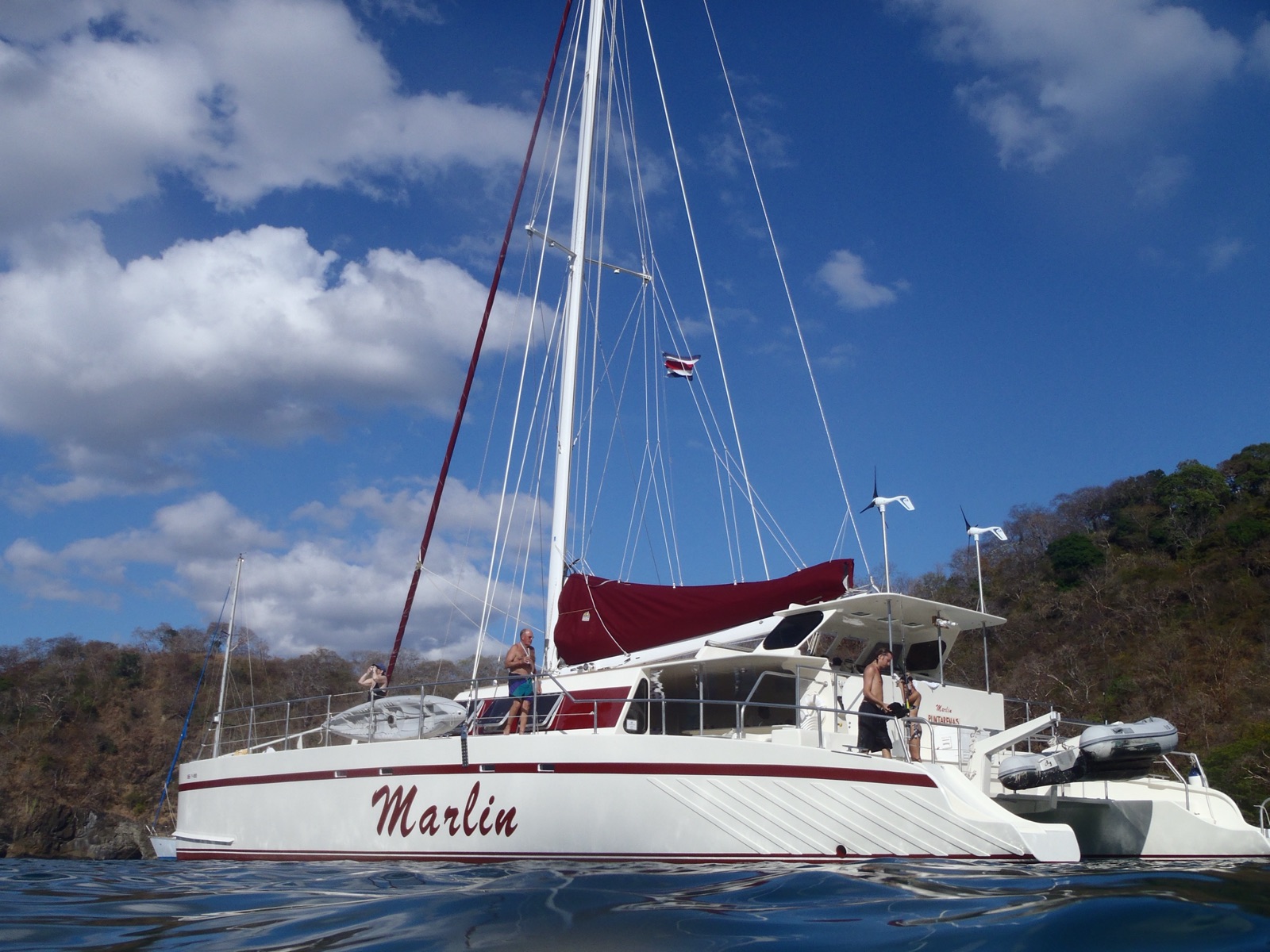
Most sailboats you'll step aboard in Costa Rica are either catamarans (two hulls, stable and roomy) or monohull sloops (one hull, one mast, more of a classic sailing feel). Knowing the basic types, rigs and parts helps you choose the right day sail or charter and understand what the crew is doing.
What counts as a sailboat
A sailboat is any boat that gets all or most of its push from the wind. In practice, almost every sailboat you'll book in Costa Rica also has an engine (usually a diesel inboard on bigger boats, sometimes an outboard on small ones). Crews motor out of the anchorage or marina, raise the sails once there's room and wind, and often motor home if the breeze dies late in the day. That's normal, and it's worth knowing so you're not surprised when the engine stays on for part of a "sail."
Sailboats range from a 4-meter dinghy you can tip over with one bad move to a 30-meter schooner with a full crew. For visitors, the useful split is by hull shape, then by rig (how the masts and sails are arranged), then by what's under the water.
Hull types: one, two or three
Monohulls have a single hull and a heavy keel underneath that keeps them upright. Under sail they lean (heel) to one side, which some people love and others find unsettling at first. They tend to point closer to the wind, move with a smooth, rolling motion in swell, and feel like "proper" sailing. Most private yachts in the 30 to 50 foot range are monohulls.
Catamarans have 2 hulls joined by a deck and a wide platform in between. Because they're so wide, they barely heel, which is why they dominate day tours on Costa Rica's Pacific coast. You get lots of shade and deck space, nets at the bow for lying in the sun, steps down to the water for swimming and snorkeling, and less chance of seasickness for most people. The trade-off: in short, steep chop they can slam a bit, and they don't sail as close to the wind as a good monohull.
Trimarans have a main hull plus 2 smaller outer hulls (floats). They're light, fast and stable, but less common for tours. You might see one at a regatta or on a private charter.
Sailboards and small dinghies sit at the other end of the scale: windsurfers, small racing dinghies and beach catamarans. These are what you'd use for lessons at a beach or lake rather than for a day out with lunch.
Keels, centerboards and why depth matters
What's under the water decides where a boat can go.
- Fixed keel: a heavy fin, often lead or iron, bolted under a monohull. It gives stability and lets the boat sail against the wind, but it means the boat needs deeper water. A typical cruising monohull might draw 1.5 to 2 meters.
- Centerboard or daggerboard: a light fin that lifts up. Common on dinghies and some catamarans, it lets the boat get into shallow bays and right up to a beach.
- Mini keels on catamarans: most cruising cats have 2 small fixed keels, so they draw much less water than a monohull of the same length. That's one reason tour cats can tuck into shallow coves for snorkeling.
In Costa Rica, depth matters around river mouths, in parts of the Gulf of Nicoya and in the channel behind Puntarenas, where shallow water and sandbars limit deeper boats.
Rigs: how the sails are arranged
The rig is the mast, the sails and the wires that hold it all up. The names you'll hear most:
- Sloop: 1 mast, a mainsail behind it and a single headsail (the jib or genoa) in front. By far the most common rig on modern yachts and on many catamarans. On a fractional sloop, the forestay meets the mast below the top, which makes the rig easier to tune for performance.
- Cutter: 1 mast with 2 headsails. Popular with long-distance cruisers because it gives more sail combinations in heavy weather.
- Ketch: 2 masts, with the shorter rear (mizzen) mast in front of the rudder post. Splitting the sail area into smaller pieces makes each sail easier to handle.
- Yawl: also 2 masts, but the small mizzen sits behind the rudder post.
- Schooner: 2 or more masts, with the front mast no taller than the ones behind. Classic schooners are lovely to look at and still turn up on some tall-ship voyages and heritage charters.
- Cat rig: a single mast right at the front and just one sail. Simple, and common on small dinghies.
- Square-rigged ships: the big tall ships with rectangular sails on horizontal spars. You'll only see these on special voyages or visiting training ships.
The parts you'll hear on deck
Crews will happily explain as they go, but these words help:
- Bow / stern: front / back. Port / starboard: left / right when facing the bow.
- Mast and boom: the upright pole and the horizontal pole along the bottom of the mainsail. Mind your head when the boom swings across.
- Halyard: a line that raises a sail. Sheet: a line that trims (pulls in or lets out) a sail.
- Helm: the wheel or tiller that steers. Winch: the drum that gives you power to pull a line tight.
- Tacking and gybing: turning the bow or the stern through the wind so the sails swap sides. When you hear "ready about" or "gybe ho," keep low and clear of the boom.
How a sailboat moves against the wind
A sail works a bit like an airplane wing turned on its side. With the wind coming from the side or a little ahead, the curved sail creates lift that pulls the boat forward, and the keel stops it sliding sideways. No sailboat can go straight into the wind, so to get somewhere upwind it zigzags (tacks) at an angle of roughly 40 to 50 degrees either side of the breeze. Reaching, with the wind on the side, is usually the fastest and most comfortable point of sail, and it's what crews aim for on a sunset cruise.
Which type suits which trip in Costa Rica
- Snorkel and sunset day tours: almost always catamarans, because they're stable, shaded and easy to swim from. See our sailing tours section and the local picture in Sailing in Costa Rica.
- Private charters and multi-day cruising: monohulls and cruising cats, crewed or (for experienced sailors) bareboat. Browse yacht charters and marinas.
- Learning to sail: small dinghies and beach cats at a sheltered beach or lake.
- Fishing: these are almost always powerboats, not sailboats. See An introduction to sportfishing.
Many sail trips include time in the water, so it's worth reading An introduction to snorkeling or An introduction to kayaking before you go.
A very short history
People have sailed for at least 5,000 years. Ancient Egyptians used square sails on Nile boats, and Austronesian sailors crossed huge stretches of the Pacific in outrigger and double-hulled canoes, the ancestors of today's catamarans and trimarans. The fore-and-aft rigs used on almost every modern yacht grew out of later European and Arab designs that could sail closer to the wind. Fiberglass hulls in the 1950s and 60s made small sailboats affordable, and that's what opened sailing up to holidaymakers.
Frequently asked questions
Is a catamaran or a monohull better if I get seasick?
Most people find a catamaran easier, because it heels very little and rolls less at anchor. Sit in the middle, look at the horizon and avoid going below deck if you feel queasy.
Do I need sailing experience to go on a sail tour?
No. Day tours and crewed charters are run by the crew. You can help with lines or steering if you'd like, but you don't have to.
Can I rent a sailboat and skipper it myself in Costa Rica?
Bareboat options are limited compared with the Caribbean or Mediterranean. Expect to need a recognized sailing certificate and proven experience, and many charters in Costa Rica come with a captain.
Why does the engine run on a sailboat tour?
To leave and enter anchorages safely, to keep to a schedule, and when the wind is too light. Afternoon breezes on the Pacific coast are often best, so crews raise sails when they can.
What should I wear on a sailboat?
Non-marking soft-soled shoes or bare feet, a hat that won't blow off, reef-safe sunscreen and a light layer for the ride home.